The Programming Research Group is working on programming languages and software development environments. Our goal is to make programming more fun by advancing theory, design and implementation of programming languages and environments.
- Theory and design of programming languages: We are investigating for example type systems, control operators, advanced module mechanisms, and program synthesis.
- Implementation techniques for high-level programming languages: We are developing object-oriented support for high-level GPGPU programming languages, and runtime compiler frameworks.
- Improving software development environment by applying program analysis and machine-learning techniques: We are developing live programming environments for the real programmers, an environment for teaching, code completion mechanisms and debuggers.
For more and detailed research topics, please look our projects page. We welcome interested students and researchers to join us.
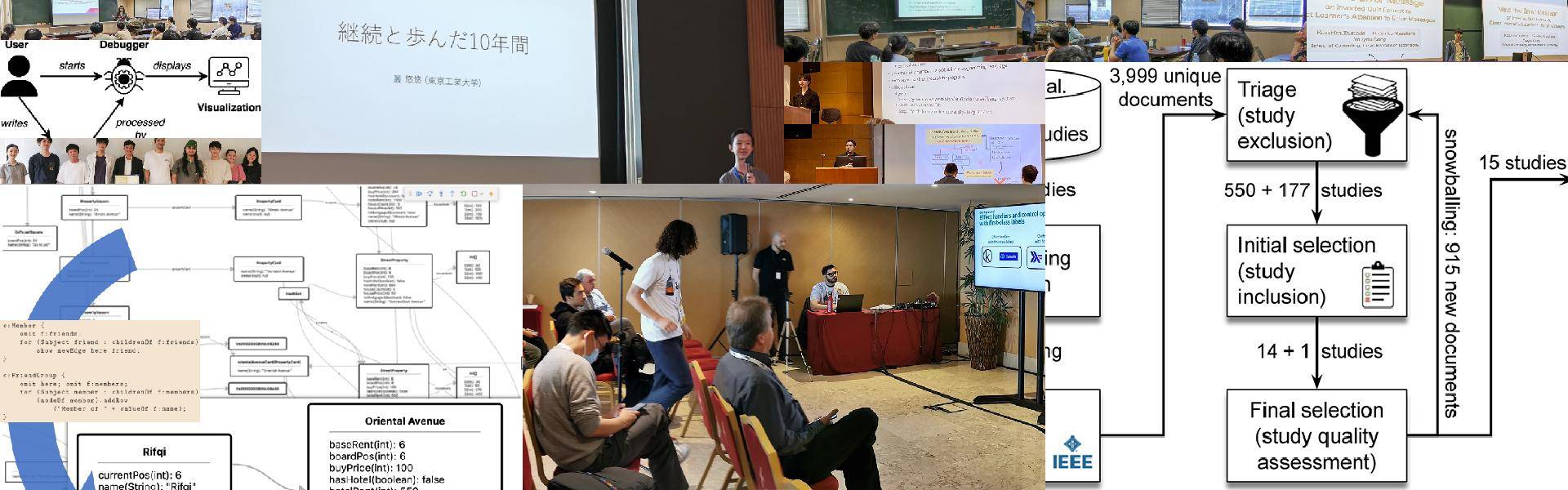
There are two presentations at the Programming Experience Workshop (PX/26), colocated with the Programming Symposium (<Programming> 2026) at Munich, Germany.
(more…)
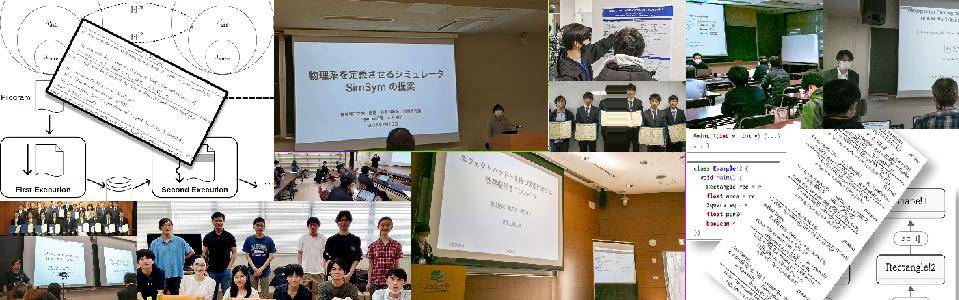
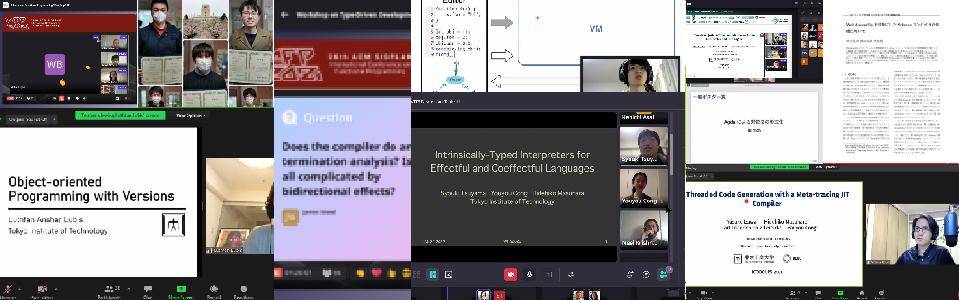
We will present the following 7 posters at the JSSST Workshop on Programming and Programming Languages (PPL2026) at Takamatsu, Kagawa.
(more…)
The following 3 papers are accepted to the JSSST Workshop on Programming and Programming Languages (PPL2026). We will present these papers at Takamatsu, Kagawa.
(more…)
A paper entitled “Implementation of Multiple Consistency Models for Distributed Transactions in a Reactive Programming Language”, authored by Suzuki, Kamina, Aotani and Masuhara, was accepted by the IPSJ Transaction on Programming.
The paper was presented at the 157rd Workshop of IPSJ SIG Programming on January, 2026.
(more…)
A paper on ‘Students’ Understanding of (Delimited) Continuations’ is accepted by SIGCSE TS 2026, to be held in St. Louis, MO, USA in February 2026.
(more…)
Funabashi presented his Bachelor’s thesis titled “Towards Supporting Learning of Accumulative Recursion via Conversations”.
Four students presented their Master’s thesis on February 3.
- Jessica Belicia Cahyono “Developing an Exercise Environment for Learning Information Modeling”
- Hironori Kawazoe “Design of Work Stealing Scheduler for Dynamic Task Parallel Execution on GPU”
- Satsuki Kasuya “Multi-Version Objects: A Python Runtime Model for Gradual Migration”
- Zhijie Xie “GuardLint: Static Analysis of GC Guard Omissions for CRuby”
 Zhijie Xie presents a paper on a static analysis of the Ruby implementation for safety of garbage collection at the 157th IPSJ Workshop on Programming held in Naha, Okinawa. This work is done with Dr. Koichi Sasada, one of Ruby’s core committers.
PRO2025-4-(15): 16:45–17:30
“GuardLint: Static Analysis of CRuby for Checking GC Guards”
○Zhijie Xie (Institute of Science Tokyo)
Hidehiko Masuhara (Institute of Science Tokyo)
Koichi Sasada (STORES, Inc.)
Project page: Making the Ruby Implementation More Robust
A paper on flexible distributed transactions for a reactive programming language is presented at the IPSJ SIG Programming Workshop held in Naha, Okinawa. This presentation is the result of a joint work with Oita University and Sanyo-Onoda City University.
(more…)
The following presentation has been accepted to POPL 2026 Student Research Competition. The work is a collaboration with Tom Schrijvers at KU Leuven.
(more…)